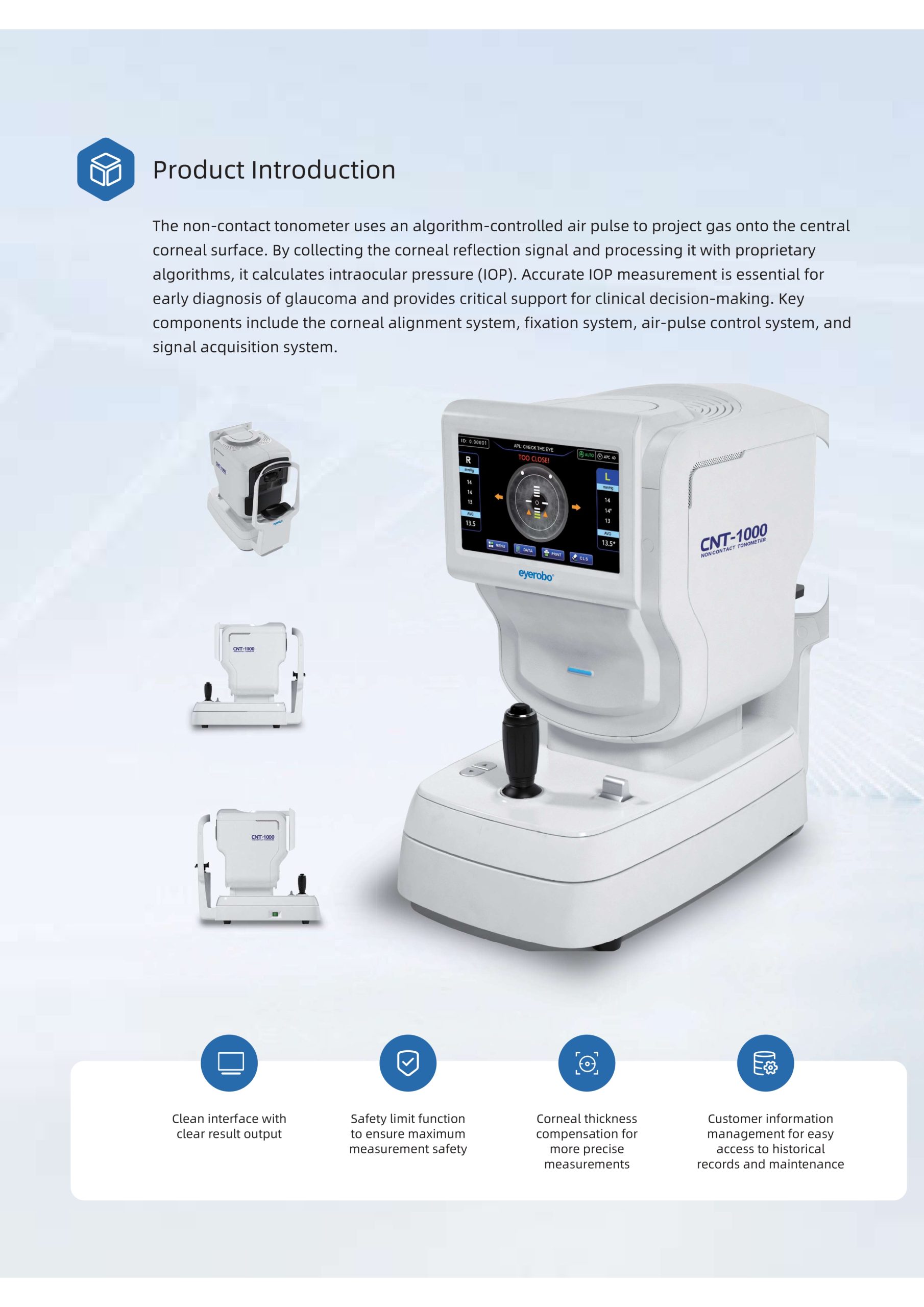
The non-contact tonometer uses an algorithm-controlled air pulse to project gas onto the central corneal surface. By collecting the corneal reflection signal and processing it with proprietary algorithms, it calculates intraocular pressure (IOP). Accurate IOP measurement is essential for early diagnosis of glaucoma and provides critical support for clinical decision–making. Key components include the corneal alignment system, fixation system, air-pulse control system, and signal acquisition system.

| Parameter | Specification |
| Brand | eyerobo |
| Model | CNT-1000 |
| Measurement Range | 0-60 mmHg (0-7.8 kPa) |
| Range Setting | 30mmHg / 60mmHg |
| Measurement Accuracy | 0.1 mmHg (0.013 kPa) |
| Working Distance | 11 mm |
| Moving Range | X: 86 mm, Y: 44 mm, Z: 24 mm |
| Air Pulse Peak Pressure | ≤82.5 mmHg (11 kPa) |
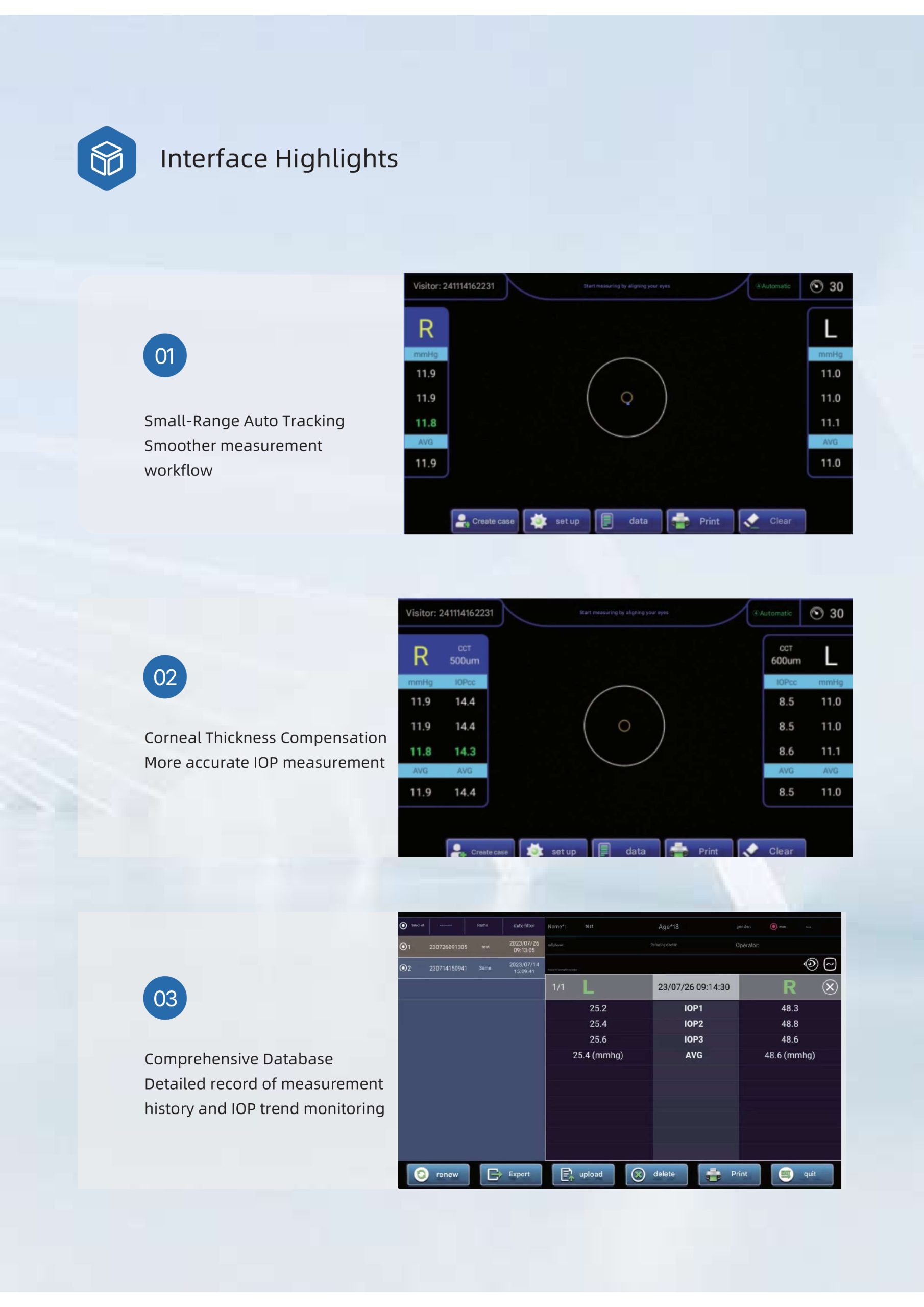
| Measurement Method | Manual + Small-Range Auto |
| Measurement Times | 1 Time / 3 Times |
| Alignment Method | In small-range auto mode, a deep-learning model locates the eye and uses the pupil-center reflex point for precise focusing. |
| Corneal Thickness Compensation | Supports manual entry and automatically calculates compensation. |
| Data Processing | Low-confidence data are filtered based on the measurement waveform. When 3 measurements are taken, a weighted average is applied to produce the final result. |
| Data Storage | Built-in case system allows tracking of historical data and displays trend curves. Data can be exported in table format. |
| Printer | Built-in thermal printer with automatic paper-cutting function. |